Submit
Upload or paste the text
Submit a .doc, .docx, .txt, or .pdf file, or paste text directly. 300 or more words of English gives the most reliable result.


Dechefr is a structured professional judgment tool that assesses written or transcribed communication for the risk of targeted violence. It evaluates emails, posts, letters and messages against twelve research-grounded indicators, producing a result ready for a trained assessor to review.
Need to manage the whole case, not just one text? Dechefr also runs inside Sentinel, our guided solution for reporting, assessing, and managing conflict, threats, and violence.
Written communication can carry indicators that bear on risk, from grievance and fixation to leakage and last-resort escalation, and reading them consistently takes a defined method rather than an experienced eye alone. Dechefr, from the French déchiffrer, to decipher, is a structured professional judgment (SPJ) tool built for that. It assesses a piece of writing or a transcript against twelve research-based indicators drawn from the literature on warning behaviors and the pathway to violence, and returns each indicator with an overall risk level. As with any SPJ instrument, the result structures the assessment rather than settling it. The judgment stays with a trained assessor.
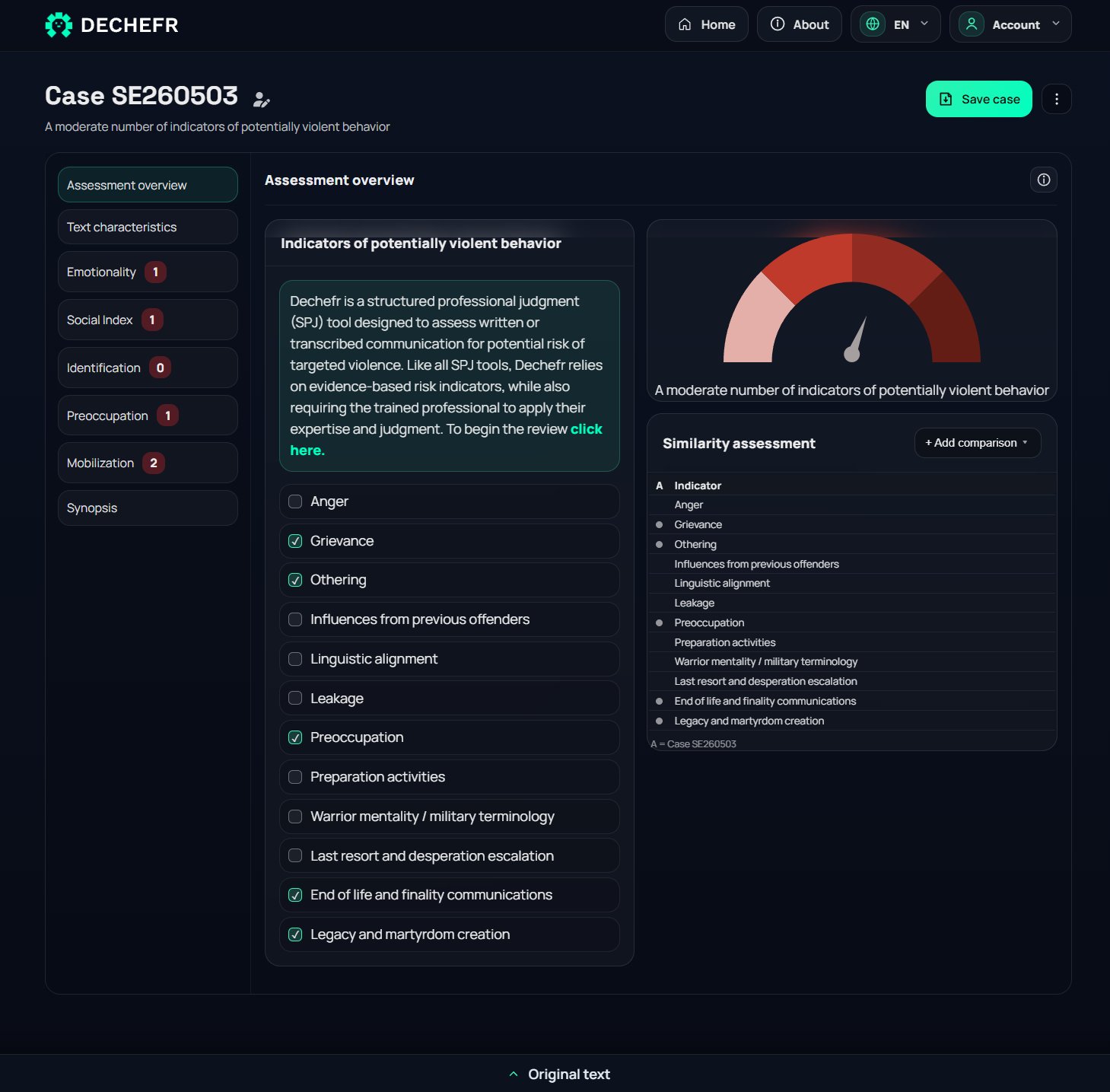
Dechefr turns a document or pasted text into a structured, transparent assessment in four steps.

Submit a .doc, .docx, .txt, or .pdf file, or paste text directly. 300 or more words of English gives the most reliable result.

A weighted overall risk level gives a fast triage signal across four levels, from no indicators present to several significant indicators of potentially violent behavior. Review each of the twelve indicators with an interactive assistant, and adjust any call based on your own judgment.

See how the case compares against a reference database of violent offenders' communications and against your own case archive, showing which patterns recur and which details are particular to this case.

A structured report documents every indicator, the sentences behind it, and the overall risk level, giving you a record of how the assessment was reached.
Dechefr assesses the text and only the text. It is not swayed by who wrote it, by internal pressure, or by the fatigue that builds over a long caseload, and it applies the same criteria to the hundredth message as to the first. That makes it a stable second opinion for assessors to weigh their own judgment against, whether it runs on its own or inside Sentinel.
Dechefr looks for twelve indicators, drawn from the literature on warning behaviors and the pathway to violence.
Expressions in the communication that indicate anger.
An unmet need that fuels a sense of being wronged, the kind that can drive revenge or retribution.
Us-versus-them thinking that marginalizes a "them" group as an outgroup.
Communication of intent to harm a specific target.
Interest in or admiration for previous offenders or attacks.
Military jargon and the adoption of a warrior perspective.
Extreme occupation with a person or cause.
Linguistic markers of influence from an ideology or subculture.
Violent ideation being converted into operational capability.
Violence perceived as the only remaining option, with urgency and closing alternatives.
Anticipation or acceptance of death, capture, or irreversible consequences.
Violence framed as historic, justified, or worthy of remembrance.
The same assessment engine and the same twelve indicators, whether Dechefr stands alone or sits inside Sentinel. Start with the scope your team needs today, and add the case-management layer when you're ready.
For analysts, forensic linguists, and researchers who need to assess a single piece of written communication.
For teams that receive reports and manage cases end to end, not just single texts.
Mind Intelligence Lab was founded by researchers in threat assessment and computational text analysis. Our tools are grounded in the research literature on targeted violence, structured professional judgment, and warning behaviors in written communication, and they are developed in continuous dialogue with the practitioners who use them.
Everything in Sentinel and Dechefr is grounded in research, from the twelve indicators to the assessment workflow itself. Our team publishes in peer-reviewed journals on threat assessment and warning behaviors, and that work flows directly into the products.
Structured tools do not replace professional judgment. They support it. Sentinel and Dechefr are built to make your team's expertise more consistent, more transparent, and easier to defend.


Campus threat assessment teams managing student-of-concern reports and communications.

Corporate security and HR handling workplace violence prevention and insider concerns.

Agencies and authorities receiving threats and hostile communications directed at staff and officials.
Professionals assessing threatening communications as part of protective operations.

Contact us for more information, and we'll walk your team through the full workflow, from intake to assessment to case management, using realistic material.
Contact usReady to enhance your organization's security posture? Contact and Mind Intelligence Lab to discuss how our advanced insider threat detection and personnel vetting solutions can protect your critical assets.
We use cookies to enhance your browsing experience and analyze site usage. You can choose which types of cookies to allow below. Read more about our privacy policy